Thursday, August 14, 2008

wheat harvest


boys, their cousins (and Uncle) from England all helping -- for a few minutes, at least. Won't know yields until I get the grain threshed and winnowed. It looks better than the past few efforts, but still not the 300 pounds I was aiming for when I fenced off the 3,000 sq. ft.

performance data on cob/clay ovens

Here's a valuable perspective on the benefits of smaller, easier, cheaper, "faster-cooling" ovens, and a working baker's comparison w/the classic Alan Scott brick oven design (which isn’t always the best option for someone who wants to start small and simple).

The baker is Noah Elbers, who runs a small bakery in New Hampshire. There are some nice photos of him and his oven(s) on the web, but he's clearly spending his time in the bakery rather than on the computer -- hurrah! He does participate in the brickoven group on yahoogroups, which is where this comment came from. Copied here w/his permission...

-- Kiko Denzer

Re: Thermal Mass
Posted by: "noah elbers" breadwks AT sover.net
Thu Jun 26, 2008 4:40 pm (PDT)

When I was just starting out commercially I baked in a minimally insulated, 4-5" thick cob/clay oven. Here was my schedule and quantities just to give you an idea. This was a 5 foot deep oven, 3 ' wide app. but scaling up or down does not affect the number of loads much at all.

I would fire the oven from cold at 4:30 am. With three stokings (a brisk fire most of the time) the oven was fully saturated by 10:30 am.

Production:
2 loads of pizza (6 each load)
3 loads of bread (30-36 loaves each load)
2 loads of cookies or bars (totaling 150 pieces) sometimes pies, but not always, up to 15 on a regular basis, but over 100 at thanksgiving and christmas.
25 lbs of granola
overnight beans
By the end of the next day the oven had cooled enough to dry fruit like apples and plums, or herbs and tomatoes from the garden. Three days after sweep out the oven would be back to air temp.

Light up was very easy in this oven even from cool temps since it heated so fast, wood quantity was miniscule compared to my later AS design, and baking quality when I was within it's production capacity was better I feel.

When I built the AS oven, a 4X6, I routinely baked upwards of 700 lbs of dough on a single firing, (500 loaves) and a few times over 1000 lbs of food (bread plus wedding catering). Those things when properly heated can really hold on to some heat, but until they are nice and soaked with heat (something I didn't fully appreciate until after two years of baking in it) I don't think they bake very well.

When I retired my AS it took well over a month for it to come back to room temp. Amazing, but not useful for home bakers. The other downside of the AS design for home use I think is that once the thing is fully heated, you either need to wait a long time before it enters the lower temp zones better for more delicate things, or you need to have huge amounts of food to bake. The low mass oven will drop lazily but steadily once it is up to full heat, and in a matter of hours you can go from great pizza to great lemon meringue pie. Half an hour at pizza temp, 2 hours in the bread zone, 5 hours for cookies and desserts, 12 hours for braising and roasting, 24 hours for drying etc.

I have no agenda here, just ten years of small scale commercial baking experience that spans three ovens now. I was basically a home baker when I started, the business grew and required greater baking capacity, and I now no longer bake in a black oven. I think retained heat baking is fascinating, rewarding, and generally as good as any other cooking method. My motive in going on and on about this is to help people who have not baked with retained heat understand some of the heat dynamics of different thermal materials. Saving on costs, fuel, air pollution are tangential for me. The experience of using the oven is what I care about most, and I share this from my experience with the two types of ovens. (now three, but the Llopis is a whole different animal)

Noah Elbers
Orchard Hill Breadworks
breadwks AT sover.net
East Alstead NH 03602
(603) 835 7845

Sunday, July 20, 2008

more images of recent sculpture

more images of sculpture:
The reddish leaf pattern is one of a pair of relief pieces in earthen plaster, which were done to decorate side panels on one of the performance stages at the Kerrville folk festival in Kerrville, Texas. It was a shared project that came out of a decorative plasters workshop at the Texas Natural Building Colloquium — many folks took part, all drew up various ideas, and the group chose this pattern, which is one I’ve been working and re-working in various materials and various settings for several years. This is the biggest!

Friday, July 18, 2008

recent sculpture


The tall cedar piece I just finished for a friend who had experimented with growing wheat; she asked for a vertical sculpture to fit a space in front of her house. All the grasses were just coming up when I started, so my model was a very early stage of growth when the first leaves are just unfurling. I started w/out drawings, which meant that when I needed a second look, the grasses had advanced to a completely different stage, and I had to work from memory and imagination. The piece of cedar was probably cut from an old snag by a local homesteader, sometime in the early 1900s, and split into a post that held up a barn. When the homesteader’s grandson repaired the barn, he took a couple of old posts out, and I got lucky. There was an old square nail embedded in the wood, which shows up about 1/3 of the way up, as a dark bruise and a scar. I finished it with a torch and oil.

Wednesday, July 9, 2008

Oven dome height for different size ovens

In the space of two days, I got two emails from people asking the exact same question. So here’s clarification, which I’ll have to include in the next printing! Thanks to those who wrote...

“Typical dome height” is 16” (p. 51). Some pizza ovens are lower because they’re used exclusively for pizza, which means they can have a low door without losing the 63% ratio of dome to door height — and they don’t have to worry about getting a turkey through the door.

The previous edition didn’t specify an ideal height, and in fact, a high domed oven will work — the traditional southwestern horno is typically quite high. In general, however, for bread ovens you don’t want to increase oven volume any more than you have to, as it reduces the concentration of steam — and steam is what causes the formation of an ideal crust. In addition, your door would have to get higher and higher in order to maintain the 63% ratio.

If you make a really large oven, it gets much trickier maintaining the right curvature of the dome to keep it from falling in (“large” might be 10 feet wide or more...). But otherwise, I use 16” as a standard height for 22”, 27”, 36”, and larger ovens. The largest I’ve built was 4 feet across, with a 16” dome.

At that size, I was very careful to make sure that the shape of the dome was truly catenary. In fact, I made a template by hanging a loop of heavy cord so that the ends were 48” apart, and the center hung down 16”. I traced the line, cut it out, and used the template to shape the sand form so that I would be sure of the strength of the dome.

The little pic is a postcard of a typical Southwestern horno — clearly more than 16” high inside the dome.

Monday, June 23, 2008

oven ready to light


Here's a fire laid and ready to light: sticks stacked log-cabin style, w/lots of open space and air around them for good combustion, and a small teepee of fine kindling at the front, waiting for a match. Another reason I like oven-dried wood is that I don't need paper to start a fire -- just fine slivers of wood and, poof! a bright fire. In the bottom photo, you can see the clear path that inflowing air takes down the center-right side of the hearth floor, where there are no obstructions to create turbulence. 

Tuesday, June 17, 2008

new commercial oven at CSA farm


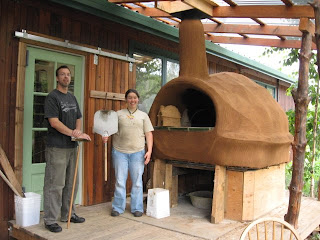
Here's a new commercial oven at Gathering Together Farm, a small farm/CSA restaurant in Philomath, Oregon, with cooks JC and Lisa posing with tools. This is a super-insulated design, with an external basket frame covered w/clay-slip-soaked burlap and insulating (sawdust-clay) plaster. When dry, the open cavity was filled w/loose perlite for insulation. The thermal layer is the standard clay/sand mix, covered with a cardboard expansion gap/thermal break (see the oven-fuel-firing-times-and-insulation post), and a layer of sawdust-clay insulation. Then about a 6" space, and the final covered frame. The base is a stout metal box. Less well insulated ovens are typically barely warm on the outside after hours of firing, so I'm expecting this one to hold its heat really well. But so far it's only had drying and test fires, and doesn't even have a baking door! Mason Trevor Norland is going to fashion stone feet and skin for the lower portion of the base.